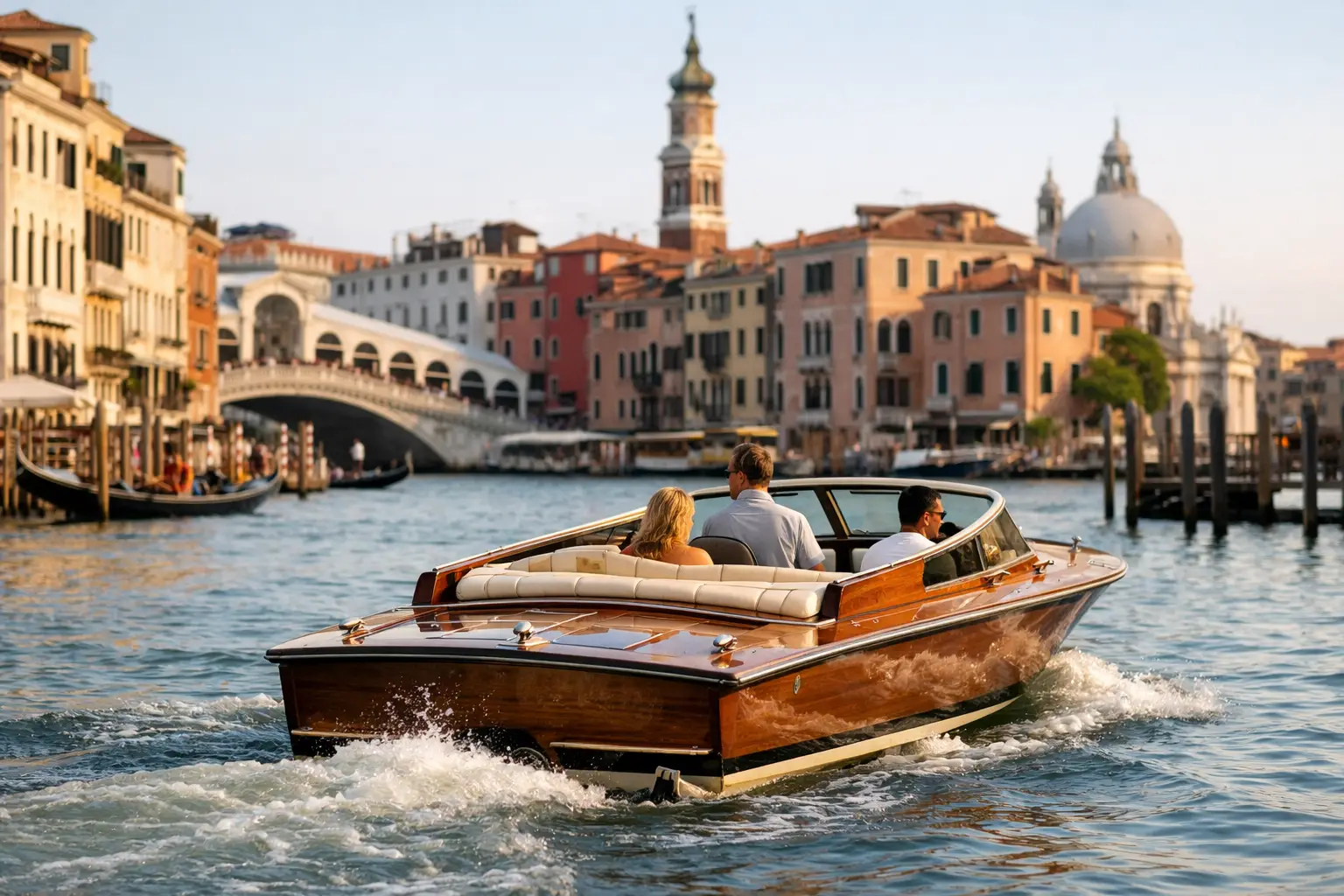
Venice Water Taxi: Is It Worth It?
You feel the difference almost immediately. Instead of following the crowd toward packed public docks or waiting with luggage on a busy quay, a Venice water taxi carries you into the city the way Venice is meant to be experienced – by water, with a direct arrival at your hotel whenever possible and a sense that the trip has truly begun.
For travelers who value comfort, timing, and a polished start, this is more than transportation. A Venice water taxi is often the smartest transfer in the city, especially after a long flight, on a special occasion, or when hotel access and luggage handling matter as much as the ride itself. It is not the right choice for every budget or every itinerary, but for many of our clients, it becomes one of those details they remember long after the trip.
What a Venice water taxi actually is
A Venice water taxi is a private motorboat transfer, typically reserved in advance, designed to move guests directly between key arrival points and Venice hotels, private palazzi, or nearby islands. Most commonly, travelers use it from Marco Polo Airport, Santa Lucia train station, Piazzale Roma, or the cruise terminal area.
The appeal is straightforward. It is private, much faster than the public vaporetto in many cases, and far more comfortable when you are arriving with suitcases, children, formalwear, or simply no interest in managing logistics after a travel day. In a city where even simple transfers can become complicated, private boat service removes much of the friction.
That said, Venice has limits that matter. Not every hotel has a private dock, and not every canal is accessible depending on water levels, traffic restrictions, or boat size. Sometimes a water taxi can bring you directly to the entrance. Sometimes it gets you very close, with a short porter-assisted walk to finish the transfer. The difference sounds minor, but in Venice it can shape the whole arrival experience.
When a Venice water taxi is worth it
The strongest case for a Venice water taxi is convenience. If you are landing at the airport and heading into the historic center, the route usually includes a land transfer from the terminal to the dock, then a private speedboat through the lagoon and into Venice proper. Compared with piecing together bus, people mover, vaporetto, and walking directions, it feels considerably easier.
It is also worth it when timing matters. If you have dinner reservations, a private guide waiting, or a carefully planned arrival tied to a honeymoon or anniversary, predictability becomes part of the luxury. Public transportation in Venice is part of the city’s character, but it is not always the most graceful option with jet lag and luggage.
Privacy is another reason. Couples often choose a water taxi because the arrival feels cinematic without trying too hard. Families choose it because no one wants to negotiate stairs, docks, and crowded platforms with children and bags. Professionals and high-end leisure travelers choose it because they prefer a smooth handoff rather than a logistical puzzle.
The cost is the main trade-off. A Venice water taxi is significantly more expensive than shared transportation. If you are traveling light, staying near a major vaporetto stop, and comfortable with some self-navigation, public options may be perfectly reasonable. But if you are comparing not just price, but ease, time, and the quality of your first impression of Venice, private transfer often earns its place.
Airport to hotel: the most popular route
For many visitors, the airport transfer is where a private boat makes the biggest impact. After arriving at Marco Polo Airport, you are met, guided to the appropriate dock area, and transferred by private boat toward your hotel zone. The route across the lagoon is part transportation and part introduction to Venice. You begin with open water, then gradually enter the quieter channels and more intimate scale of the city.
This is also the route where planning matters most. Airport arrivals can involve customs timing, delayed flights, porter coordination, and changing water conditions. A well-managed transfer accounts for those variables. The best experience is not simply booking a boat. It is having the right timing, the right dock access, and clear coordination with your hotel.
For travelers staying at iconic canal-side properties, a direct water arrival can set the tone for the entire stay. For smaller boutique hotels tucked into less accessible corners, the transfer may still be private and efficient, but with a final escorted walk. Neither option is a problem when expectations are set correctly.
What about train station or Piazzale Roma transfers?
These shorter transfers can be equally worthwhile, especially if you are arriving from Florence, Milan, or another Italian city with multiple bags. Santa Lucia station and Piazzale Roma can be hectic, and the walkways leading into Venice are rarely pleasant with heavy luggage. A private boat avoids much of that strain.
For shorter distances, though, value depends on your priorities. If your hotel is only a brief walk from the station and you are traveling with one small bag, a water taxi may feel like a splurge rather than a necessity. If your hotel is deeper into Venice or your arrival is part of a celebratory trip, it tends to feel entirely justified.
What to expect on board
Venice water taxis are typically polished wooden or fiberglass motorboats with upholstered seating, covered cabins, and space for a modest amount of luggage. They are private, not shared with other parties, unless specifically arranged that way.
The ride itself varies. Across the lagoon, the boat may move quickly and the water can be choppy on windy days. Inside Venice, speeds slow considerably, and the experience becomes quieter and more scenic. This is not a narrated tour, though many drivers are friendly and point out landmarks when appropriate. The real luxury is not performance. It is directness, privacy, and relief.
Travelers prone to motion sensitivity should know that the airport route can be bumpier than expected in poor weather. Those with extensive luggage should also confirm capacity in advance. A private transfer solves many problems, but only if the booking matches the realities of your group and bags.
How to choose the right service
The best Venice water taxi arrangement is not always the cheapest quoted rate. What matters is whether the service includes the details that make the transfer feel effortless: meet-and-greet, porter coordination if needed, hotel dock verification, luggage guidance, and backup planning if conditions change.
This is where travelers often benefit from concierge support rather than a generic booking platform. Venice rewards precision. Two hotels that appear close on a map may have very different water access. One may welcome guests at a private landing. Another may require crossing a small bridge and walking through narrow lanes. If those differences are addressed ahead of time, the arrival feels smooth. If not, even a premium transfer can become confusing.
The right choice also depends on your style of trip. For a honeymoon, milestone birthday, or multigenerational family journey, private arrival tends to be money well spent. For a quick city stop with minimal luggage and a practical mindset, a more modest transfer plan may be entirely sufficient.
A luxury detail that changes the trip
Venice has a way of magnifying small logistical decisions. The city is romantic, yes, but it can also be tiring when you are managing bags, crowds, and unclear directions. A private boat does not change Venice itself. It changes how you enter it.
That is why we often treat water transfers as part of the experience rather than a line item. When arranged properly, a Venice water taxi feels calm, private, and beautifully timed. It protects the mood of the trip, whether you are arriving for a celebratory weekend or beginning a longer Italian journey.
For travelers who want luxury travel, beautifully handled, this is often one of the simplest ways to begin well. And in Venice, beginnings matter.