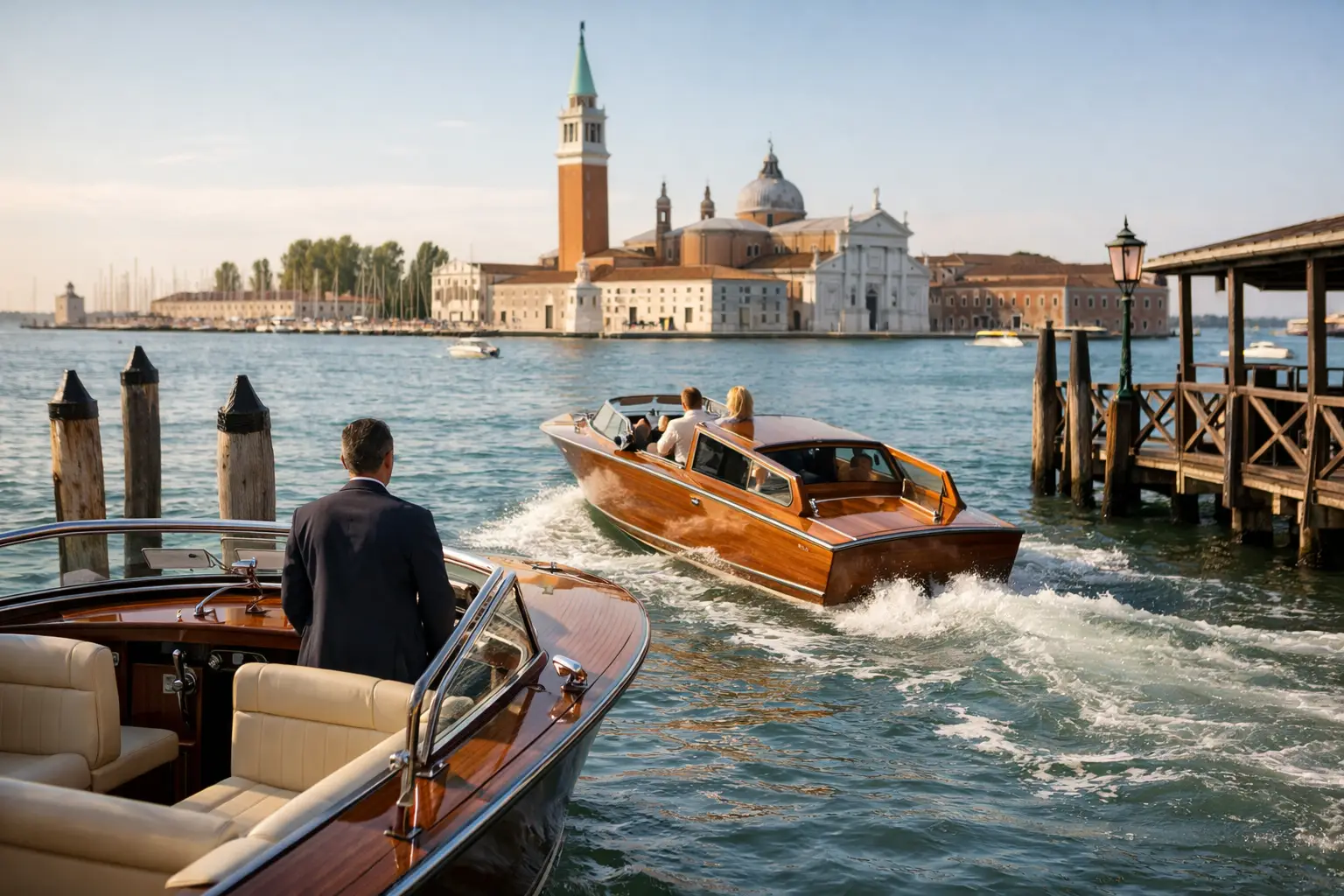
Guide to Venice Water Arrival Services
You feel Venice before you fully see it. After the airport, the causeway, or the train platform, there is a moment when the city stops behaving like anywhere else – no traffic lanes, no curbside pickup, no ordinary hotel transfer. A thoughtful guide to Venice water arrival services matters because the first 30 minutes can shape the entire stay, especially when comfort, timing, and luggage handling are part of the experience you expect.
For luxury travelers, a Venice arrival is not simply transportation. It is part logistics, part atmosphere, and part strategy. The right choice depends on where you are arriving from, which hotel you have booked, how much luggage you are carrying, and whether you want the most direct option or the best balance of cost and ease.
Guide to Venice water arrival services: what your options really look like
Venice water arrivals generally fall into three categories: private water taxi, shared water taxi, and public waterbus connections. All three can work well. The difference is how much walking, waiting, and coordination you are willing to accept.
A private water taxi is the most polished option. You are met, escorted, and transferred by boat directly to your hotel dock when possible, or to the nearest accessible landing point. If you are celebrating an anniversary, arriving after a long international flight, or traveling with multiple bags, this is usually the most comfortable choice. It is also the most cinematic. That said, it comes at a premium, and not every property in Venice has a dock that allows a true door-to-door arrival.
A shared water taxi offers a middle ground. You still travel by motor launch, but the boat may make several stops before yours. That means a lower price, but less privacy and a longer transfer time. For couples traveling light who want the feel of a water arrival without paying for a private launch, this can be a sensible compromise.
Public transportation, typically by vaporetto, is the most economical path. It also requires the most self-management. You may need to navigate lines, steps, crowded platforms, and a walk from the nearest stop to your hotel. For seasoned travelers with minimal luggage, that may be perfectly acceptable. For anyone who values ease over savings, it can feel like unnecessary friction at the very start of the trip.
Where your Venice arrival begins changes everything
The best transfer option depends first on your entry point into the city. Venice does not have one arrival pattern, and that is where many travelers misjudge their planning.
Arriving from Venice Marco Polo Airport
From the airport, private water taxi service is often the most appealing because it can begin with a dedicated meet-and-greet and continue directly from the airport dock into Venice. This avoids the extra land transfer to Piazzale Roma and keeps the experience elegant from the outset.
Shared water transfers from the airport are also common, but they can involve waiting for other passengers and a less direct route. If your flight lands early in the morning or late in the day, timing matters. Some travelers assume boats leave constantly, but schedules and availability vary.
Arriving by train at Santa Lucia Station
If you arrive by train, you are already at the edge of the Grand Canal. That makes a private water taxi particularly efficient. The handoff is usually straightforward, and the ride into the city can feel wonderfully immediate.
This is also where public options become tempting, since vaporetto stops are nearby. The trade-off is crowding. If you are arriving during peak hours with large suitcases, the difference between a private launch and a public boat feels much bigger in real life than it does on paper.
Arriving by car at Piazzale Roma
Cars stop at Piazzale Roma, which means every onward transfer becomes a handoff point. Here again, the key question is not only budget but handling. Who is moving your luggage? How far is the walk to the dock? Is your hotel accessible directly by boat, or will there be a final stretch on foot over bridges and stone walkways?
Those details matter more than travelers expect, particularly in warm weather or after a long travel day.
The hotel dock question most travelers overlook
Not every Venice hotel has direct private water access, and even those that do may be subject to tide, canal size, or local operating conditions. A proper guide to Venice water arrival services should start with the hotel itself.
Some grand properties on the Grand Canal can receive private boats at their own entrance. Others are tucked along smaller canals where certain vessels cannot approach. In those cases, your transfer may still be mostly by water, but with a final assisted walk.
This is not a flaw in the service. It is simply part of Venice. The key is to know it in advance so expectations are aligned. If your priority is a true dockside arrival, your hotel selection should support that goal from the beginning.
When private water taxis are worth it
Private service is easiest to justify when the arrival itself is part of the trip’s value. Honeymooners, anniversary travelers, multigenerational families, and couples staying at top-tier hotels usually appreciate the difference immediately.
You are paying for more than a boat. You are paying for timing control, luggage support, privacy, and a calmer first impression of Venice. After an overnight flight, that can be the difference between starting the stay feeling looked after or feeling as if you are still managing transit.
There are also practical reasons to upgrade. If you are carrying garment bags, luxury shopping, or more than one large suitcase per person, private transfers reduce hassle considerably. The same applies if you are traveling in high season, when public areas can feel crowded and disorienting.
The caveat is cost. For shorter stays, some travelers prefer to splurge on the arrival and use simpler transport later. That is often a smart balance.
Shared and public transfers: when they make sense
Not every trip requires the most exclusive option. Shared water taxis can work well for travelers who still want a stylish arrival but do not mind a few stops along the way. They are especially reasonable for daytime arrivals with light luggage and flexible schedules.
Public transport is best for travelers who prioritize value and are comfortable navigating independently. It can also be enjoyable in a local, unscripted way. But Venice is one of those places where small inconveniences add up quickly. A crowded vaporetto after a delayed flight can feel very different from the charming local experience people imagine.
If you are deciding between shared and private, ask yourself one simple question: do you want your arrival to feel managed or improvised? Neither answer is wrong. It just depends on the kind of trip you are taking.
Timing, tides, and luggage: the practical side of elegance
Venice rewards precise planning. Water traffic, seasonal demand, and occasional high water conditions can all affect your transfer. None of this is dramatic when handled properly, but it does mean that arrival services should be arranged with real attention to detail.
Luggage is the biggest operational factor. A transfer that sounds simple becomes more complicated when there are oversized bags, multiple suitcases, or a route that includes narrow walkways. If you are traveling with formalwear, photography equipment, or shopping from other Italian stops, mention it in advance.
Flight and train delays also matter. The best providers can monitor timing and adjust, but only if the booking has been structured correctly. This is one reason many travelers prefer to have these arrangements managed as part of a broader itinerary rather than booked as a standalone last-minute transfer.
Choosing the right water arrival for your style of trip
If Venice is part of a milestone trip, a private water arrival usually fits the tone best. If it is one stop on a longer itinerary and you are balancing comfort with budget, a shared launch may be enough. If you are highly independent and packing light, public transport can certainly work.
The best decision is rarely about price alone. It is about how you want to enter the city and how much effort you want to spend on the mechanics. For clients planning refined Italian journeys, this is often where concierge support proves its value. Newport Elite Concierge, for example, treats Venice arrival planning as part of the overall experience, not a disconnected transfer booking.
Venice has a way of rewarding thoughtful starts. Choose the arrival that suits your hotel, your luggage, your schedule, and the pace you want from the very first moment on the water.