Private Driver vs Train Italy for Luxury Trips
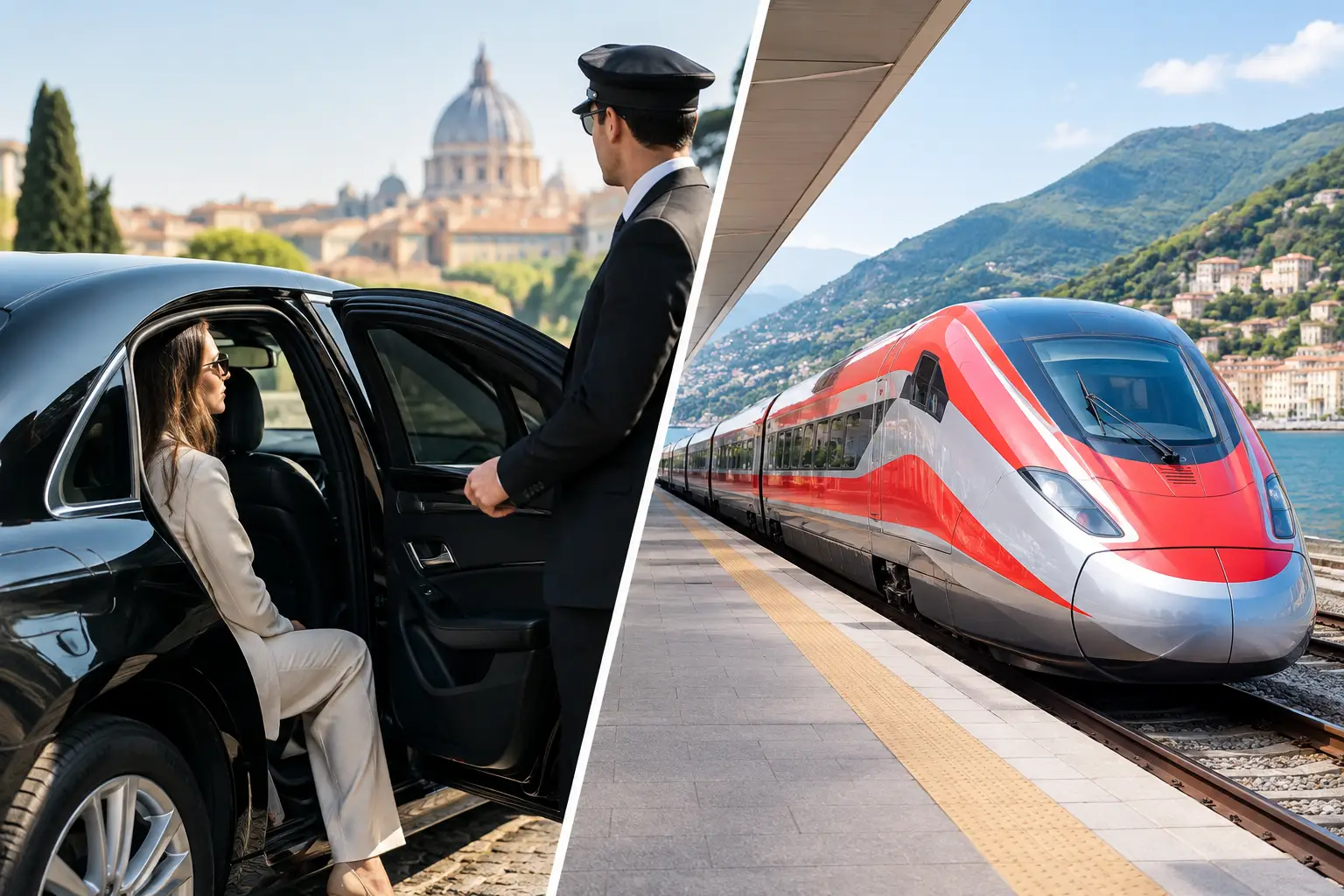
A Rome-to-Florence rail journey can be wonderfully efficient. A private drive through the Val d’Orcia, with a winery lunch and a stop in Pienza, can become one of the most memorable days of the trip. When weighing private driver vs train Italy, the better choice is rarely about luxury alone. It is about choosing the transportation that protects your time, supports your itinerary, and lets Italy feel as relaxed as it should.
For travelers who value thoughtful pacing, the strongest Italian journeys often use both. High-speed rail handles major city connections beautifully, while a private driver gives the countryside, coast, and more complex arrival days the care they deserve.
Private Driver vs Train Italy: The Essential Difference
Italy’s high-speed rail network is one of Europe’s great travel advantages. On principal routes, trains are fast, comfortable, and refreshingly direct. Rome to Florence, Florence to Venice, and Milan to Rome can be easier by rail than by car once airport-style transfers, traffic, and parking are considered.
A private driver offers something different: control. Your car is ready when you are, your luggage stays with you, and the route can follow your interests rather than a fixed timetable. This is particularly valuable when your hotel is outside the city center, your party includes several travelers, or a transfer is meant to be part of the day rather than time to be endured.
Neither option is automatically more refined. A well-chosen train itinerary can feel polished and effortless. A driver on the wrong route can mean spending extra hours in traffic. The art is knowing where each one belongs.
When the Train Is the Better Choice
Between Italy’s major cities
For direct travel between Rome, Florence, Bologna, Milan, Naples, and Venice, high-speed rail is often the clear winner. First-class service offers generous seating, luggage space, climate control, and a calmer experience than driving on busy intercity roads. From central Rome to central Florence, rail can be substantially quicker door to door than a private car.
The train also allows everyone in your party to relax at once. There is no navigation, no traffic, and no question of where a vehicle may enter a historic center. For couples moving between landmark hotels near major stations, this can be a highly elegant and practical choice.
A private transfer can still make sense for a very early departure, an evening arrival, or significant luggage. But for a straightforward city-to-city route, a first-class train paired with private station transfers gives you comfort without overcomplicating the day.
When the itinerary is centered on cities
City-focused travelers do not need a car waiting outside each morning. Rome, Florence, Venice, and Milan are best experienced on foot, by water, or with carefully arranged local transfers. In fact, driving into central historic districts can introduce avoidable restrictions, parking logistics, and delays.
Venice is the most obvious example. Rail brings you directly to Santa Lucia station, where a private water taxi can continue the experience to your hotel entrance. There is no road transfer that can replicate the pleasure or practicality of arriving by water.
When value matters alongside comfort
Train pricing is generally more transparent than private driving, especially for two travelers on a simple route. Premium rail seats can still represent excellent value, leaving room in the travel budget for a private guide, a special tasting menu, or an exceptional hotel upgrade.
Advance planning matters. Popular trains, preferred seat configurations, and holiday weekends can sell out or become expensive. A curated itinerary accounts for these details before they become a last-minute compromise.
When a Private Driver Is Worth It
The countryside and smaller villages
Italy’s most enchanting places are often beyond the rail lines. Tuscany’s hill towns, Umbria’s vineyards, the villages of Puglia, Lake Como’s less accessible corners, and much of Sicily are far easier with a private driver. Public transportation may exist, but it can be infrequent, indirect, and poorly suited to travelers with luggage or dinner reservations.
A driver turns a transfer into a tailored experience. Rather than traveling from Florence to a countryside resort in a single uninterrupted stretch, you might pause at a family-run winery, browse a ceramics workshop, or take a quiet lunch overlooking the vineyards. The day retains structure, but it feels personal.
This is also where native destination knowledge matters. The most appealing route is not always the fastest one, and the most beautiful town is not always the one receiving the most attention online.
The Amalfi Coast and other demanding roads
The Amalfi Coast rewards travelers who avoid driving themselves. Its roads are narrow, winding, busy, and not designed for visitors negotiating a new country from behind the wheel. A professional local driver understands the rhythms of the route, appropriate drop-off points, and how to time a day around traffic patterns.
The same principle applies to alpine roads, rural wine regions, and transfers involving a series of small towns. You are free to enjoy the scenery, have wine with lunch, and arrive without the fatigue of managing the journey yourself.
For coastal stays, a driver can also make the difference between a rushed checklist and a well-paced day. Positano, Ravello, Pompeii, and a private boat departure can be arranged in a sequence that respects actual travel time, not just map distance.
Families, groups, and substantial luggage
Private driving becomes more compelling as the party grows. For four to six travelers, the cost per person can compare favorably with premium rail tickets, station transfers, and the practical challenge of moving multiple bags through crowded platforms.
It is especially helpful for multigenerational families, honeymooners traveling with formalwear, and guests arriving after an overnight flight. There is real value in meeting a professional driver at the airport, settling into a pristine vehicle, and allowing the first hours in Italy to unfold quietly.
The Cost Question Is More Nuanced Than It Appears
A train ticket and a driver quote are not directly comparable unless you look at the complete day. Rail costs may include first-class tickets, private transfers on both ends, porter assistance where needed, and the price of lost flexibility if your hotel is far from the station. A private-driver quote may include vehicle time, tolls, fuel, luggage capacity, and the ability to make meaningful stops along the way.
For a couple traveling directly between central city hotels, rail is usually the more economical choice. For a family headed from a Rome hotel to a villa in Umbria, the private vehicle may offer stronger value and considerably less friction.
The question to ask is not simply, “Which is cheaper?” It is, “What does this choice allow us to do with the day?” A lower transportation cost is not a bargain if it creates a stressful arrival or eliminates the experience you hoped to have.
A Refined Approach: Use Both
The most balanced itineraries rarely commit to one mode of transportation for the entire trip. Consider arriving in Rome with a private airport transfer, taking high-speed rail to Florence, using a driver for a full day in Chianti and a transfer into Tuscany, then returning to rail for Venice. This approach is efficient where Italy is efficient and indulgent where the destination asks for more time and access.
It also gives each region its proper mood. Train travel suits the energy of Rome, Florence, and Milan. A private car suits the open landscapes of Tuscany, the theatrical curves of the Amalfi Coast, and the slower rhythms of Puglia.
At Newport Elite Concierge, transportation is planned as part of the experience, not treated as an afterthought. The timing of your arrival, the location of your hotel, the size of your party, and the occasions you are celebrating should all shape the recommendation.
Details That Deserve Planning Before Departure
Train travel is simple when the stations, platforms, transfer timing, and luggage plan have been considered. Major Italian stations can be busy, and some historic hotels require a short walk through pedestrian areas after your car drops you off. Private transfers should be chosen with equal care: the right vehicle size, local access restrictions, realistic driving times, and stops that enhance rather than interrupt the day.
If you are connecting to a flight, cruise, private boat, or a reservation with a strict cancellation policy, build in a comfortable margin. Italian travel is full of pleasures, but it is not the place to schedule every movement to the minute.
For most discerning travelers, the answer to private driver vs train Italy is not a permanent preference. Let the route decide. Take the train when it delivers you swiftly into the heart of a city, and choose a private driver when the road itself deserves to be part of your Italian story.